
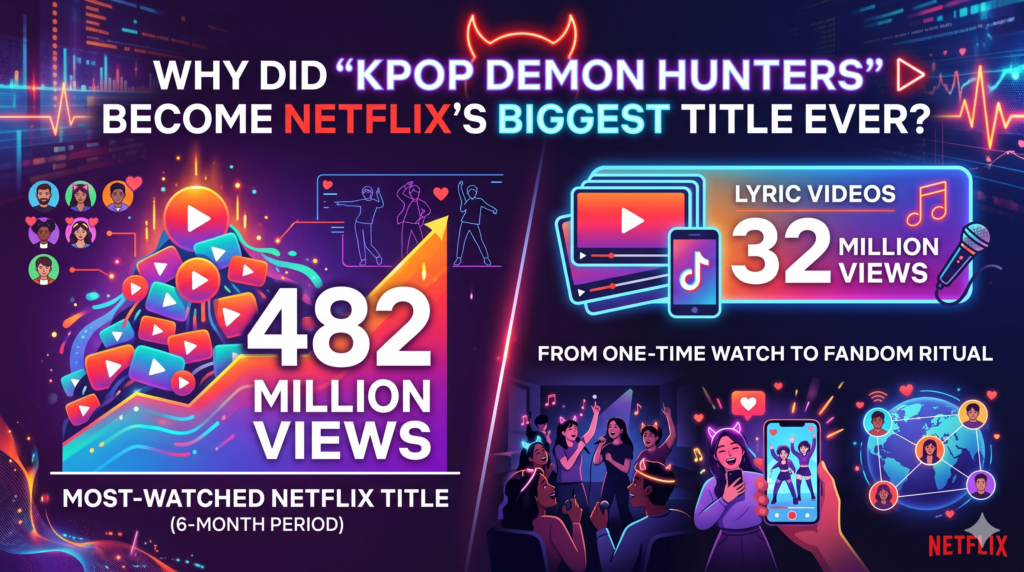
Netflix dropped its What We Watched report for the second half of 2025, and one number is doing all the talking: 482 million views for KPop Demon Hunters. That’s not “big hit” territory. That’s “biggest title in Netflix’s history, movie or show, ever” territory.
For context, Wednesday Season 2, a returning juggernaut from an established franchise, pulled 124 million. Stranger Things Season 5, the final season of one of the most-hyped shows in streaming history, got 94 million. KPop Demon Hunters beat both of them combined, and then sometitles like Happy Gilmore 2 (135M), Wednesday season 2 (124M) and Stranger Things season 5 (94M) also sitting comfortably in blockbuster territory. Screen Realm
But here’s the stat that actually tells you what happened: the KPop Demon Hunters Lyric Videos alone pulled in 32 million views. Netflix
People didn’t just watch this movie. They went back for the lyric videos. That’s not viewership. That’s a ritual.
The number that actually matters
Anyone can have a hit. Streaming is full of one-and-done blockbusters — big opening weekend, steep drop-off, gone from the cultural conversation in three weeks. The lyric video number is the tell that this didn’t happen here. It wasn’t just watched. It was replayed, shared, and treated like an event. Screen Realm
That’s the actual marketing lesson buried in this story. A 482M view count tells you reach. A 32M lyric-video view count tells you behavior: repeat engagement, song-level obsession, the kind of content people return to outside the context of “watching the movie.”
Why this is a content marketing case study, not just a streaming headline
If you build content, market brands, or run a blog (hi, that’s literally what we’re doing here), this is worth studying as a demand-engineering case, not pop culture trivia. Three things stack up:
1. It gave fans a second product to consume.
The film wasn’t the whole offer; the songs were a separate, snackable, shareable layer. Lyric videos are low-cost-to-produce, high-replay-value assets. They turn a two-hour watch into an ongoing content loop. If your brand or blog only has one format people can engage with, you’re capping your own ceiling.
2. Music is the cheapest fandom multiplier that exists.
Songs get covered, lip-synced, stitched, and remixed in a way that a plot point never will. KPop Demon Hunters didn’t need a marketing team to manufacture virality after launch: the music did the distribution for free, on TikTok, on Instagram Reels, wherever Gen Z already lives.
3. The format matched the subculture, not just the audience.
K-pop already runs on a ritual fandom model: comeback content, lyric breakdowns, choreography videos, stan accounts. The film didn’t try to convert that audience into something new; it slotted directly into behavior that already existed. That’s the difference between chasing a trend and actually understanding the psychology of the people you’re trying to reach.
The takeaway for your own content or brand
You don’t need a 482-million-view outcome to learn from this. You need to ask one question about everything you publish: does this give people a reason to come back, or did they just consume it once and move on?
A blog post that’s “done” the moment someone reads it behaves like a movie nobody rewatches. A LinkedIn carousel, an Instagram series, a recurring framework people start expecting from you: that behaves like a lyric video. It’s the secondary asset that turns single exposure into a loop.
KPop Demon Hunters didn’t become Netflix’s biggest title because it was watched once by a lot of people. It became the biggest title because it gave people something to keep coming back to.