
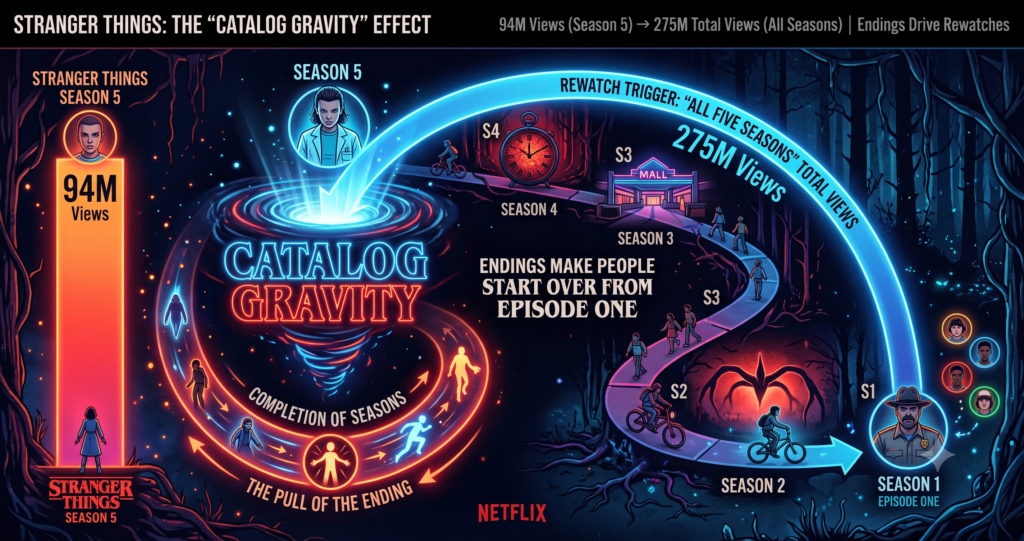
Netflix’s What We Watched report for the second half of 2025 has a stat that’s more interesting than the headline number. Yes, Stranger Things’ final season pulled 94 million views, landing second behind Wednesday Season 2’s 124 million. That’s a strong number for a show that’s been on air for a decade. Screen Daily
But here’s the part actually worth studying: every single one of the five Stranger Things seasons landed in Netflix’s top 15 most-watched TV seasons for the half, combining for 275 million views. Season 1 alone — a season that premiered in 2016 — pulled 57 million views nearly a decade after release. Screen DailyScreen Daily
That’s not nostalgia. That’s a measurable behavior pattern, and it has a name in this newsletter: catalog gravity.
What “catalog gravity” actually means
A new season launching is one event. People watch it once, post about it, move on. That’s normal release-cycle behavior — predictable, linear, and it fades fast.
What happened with Stranger Things is different. In the weeks before Season 5 even dropped, the older seasons were already climbing the charts — week of November 10 hit number one overall with 1.345 billion minutes watched, and by November 17 that climbed to 1.683 billion minutes, before a single new episode existed in the new season. People weren’t waiting for the ending. They were rewatching their way back to it. TheWrap
That’s catalog gravity: an ending creates enough emotional weight that it pulls the entire back catalog into renewed orbit. The finale isn’t just consumed on its own — it becomes the reason people re-enter a story from episode one, four, eight years later.
Why endings do this, and sequels alone don’t?
A new season of an ongoing show invites you to catch up if you’re behind, sure. But a final season does something psychologically different — it converts “I’ll get to it eventually” into “I need to know how this ends, and I need to remember everything that got us here.”
Three things stack up to cause this:
1. Finality creates urgency that mid-series releases don’t.
“Last chance to watch this universe” is a scarcity trigger. There’s no future season to catch up on later — this is the only window left to experience the story as a complete arc.
2. A long runtime means most viewers genuinely forget the plot.
A show stretched across nine years — Stranger Things’ first volume of the final season debuted three years after Season 4 — accumulates enough lore that a refresher isn’t optional. Rewatching becomes functional, not just sentimental. The Hollywood Reporter
3. The finale becomes a deadline, and deadlines move behavior.
Nielsen data showed eight consecutive weeks of pre-premiere “rewatch fever,” with older seasons climbing the charts before new episodes ever dropped. That’s people setting their own homework deadline — the release date did the scheduling for them. TheWrap
The marketing lesson hiding in a Netflix metric
If you’re building content, a brand, or a body of work — this is the actual takeaway: an ending isn’t just the end of attention, it’s a trigger that resets attention to the beginning.
Most content strategies treat the finale of anything — a campaign, a series, a launch arc — as the close-out moment. The data here says the opposite. A well-built ending doesn’t conclude a story’s relevance; it reactivates the entire archive that came before it.
If you’ve built up a body of content — old posts, a back catalog, a content series — the move isn’t to let it sit. It’s to engineer a “final chapter” moment that gives people a reason to go back to the start. A decade-old first season pulling 57 million views in one six-month window isn’t an accident of nostalgia. It’s catalog gravity, doing exactly what it’s built to do. Screen Daily